Mapping consortium‑chain mechanics onto the Angel OS blockchain substrate

Angel OS Phase 3 builds on the deterministic, hash‑linked ledger from Phase 1 and adds the consensus, contract, and legal layers required to turn that ledger into a fully constitutional blockchain — the Angel Chain.
This appendix maps the mechanics from Bambara, Allen et al., Blockchain: A Practical Guide to Developing Business, Law, and Technology Solutions (McGraw‑Hill, 2018) onto the Angel OS architecture. The book’s emphasis on permissioned/consortium chains, smart contracts, DAO liability, and Merkle integrity is exactly the foundation Phase 3 requires.
Phase 1 gave us the data layer (tokenLedger.ts). Phase 3 gives us the governance + consensus + regulatory substrate.
🔷 1. Chain Type → Permissioned Consortium (Not Public PoW) “Consortium — consensus is controlled by a preselected set of nodes and rules for achieving consensus.” — Bambara Angel Chain uses Delegated Proof of Human Worth:
Each Diocese (enterprise) is a consortium member 21 elected Guardian‑Angel validators form the node set Influence is earned through verified human contribution, not wealth or hashpower
Why not PoW or PoS? Book MechanismAdopt/RejectReason Proof of Work❌ RejectEnergy waste; plutocracy by hashpower Proof of Stake❌ RejectWealth ≠ worth Consortium Consensus✅ AdoptValidators elected on karma + trust
The book’s recommended stacks — Hyperledger Fabric, Corda, Quorum — align with Angel Chain’s architecture. Fabric chaincode is the leading candidate for float‑backed issuance.
🔷 2. Block Structure → Add a Merkle Root to Phase‑1 Hash Chain Bambara’s block header:
“Merkle root, timestamp, nonce, transaction list…” Phase 1 already hash‑links every ledger entry. Phase 3 wraps those entries into blocks:
Merkle root over TokenLedger entries Previous block hash Validator quorum signatures (≥⅔) No mining, no nonce, no energy burn
This is BFT‑style finality (Fabric/Corda class), giving human‑scale block times (~5 minutes) without PoW.
🔷 3. Smart Contracts → Issuance + Conversion Rules Bambara’s Ch. 6 covers Solidity, chaincode, and smart‑contract patterns. Angel Chain uses two contract surfaces:
1. Issuance Contract (AT minting) Mints AT only by debiting the Diocese float Enforces the buildTransfer invariant on‑chain Prevents unbacked issuance by any validator
2. Conversion Contract (AT → external value) Rate‑limited KYC‑tier gated Justice‑Fund + float‑reserve checked
KC has no conversion contract — its non‑convertibility is structural.
Recommendation: Run these as Fabric chaincode on the private consortium chain, with an optional ERC‑20‑style bridge only at the convertibility edge later.
🔷 4. DAO + Legal Layer → The Convertibility / Regulatory Gate Bambara’s DAO chapter is the most important for Phase 3.
Key confirmations:
Governance = a DAO The federated monetary‑policy quorum is legally a DAO and carries jurisdictional + service‑level liability. → Monetary‑policy votes require a constitutional wrapper, not just code.
Convertibility = regulated activity AT → USD is money movement → money‑transmitter / e‑money exposure. → KC stays non‑cashable; AT cash‑out is KYC‑gated + Guardian‑Angel approved.
Custody = Diocese‑held keys (initially) Bambara’s “Autopsy of a Wallet Bug” highlights key‑management risk. Phase 3 begins custodial — “the Diocese is its own bank” — before any self‑custody option.
🔷 5. Phase Mapping Summary Book MaterialAngel OS Implementation Consortium consensus (Fabric/Corda)Delegated Proof of Human Worth, 21 validators Merkle block headerBlock layer over Phase‑1 hash‑linked ledger Smart contracts / chaincodeIssuance + conversion as Fabric chaincode DAO jurisdiction & liabilityKC non‑cashable; AT cash‑out KYC‑gated; custodial keys
🧩 Net Result Nothing in Phase 3 blocks the existing slices (wallets, ledger collections, quest payouts, internal balances). The ledger semantics are already correct — Phase 3 simply swaps in a constitutional blockchain substrate beneath them.
Bambara’s framework validates the path: consortium consensus + Merkle integrity + chaincode contracts + DAO legal rails as the real‑world foundation for Angel Chain’s convertibility step.
Source: https://github.com/The-Angel-OS/angels-os/blob/main/docs/vision/ANGEL_CHAIN_TECH_APPENDIX.md
Related Posts
Three Bodies, One Brain: The Weekend We Taught a Pool to Breathe
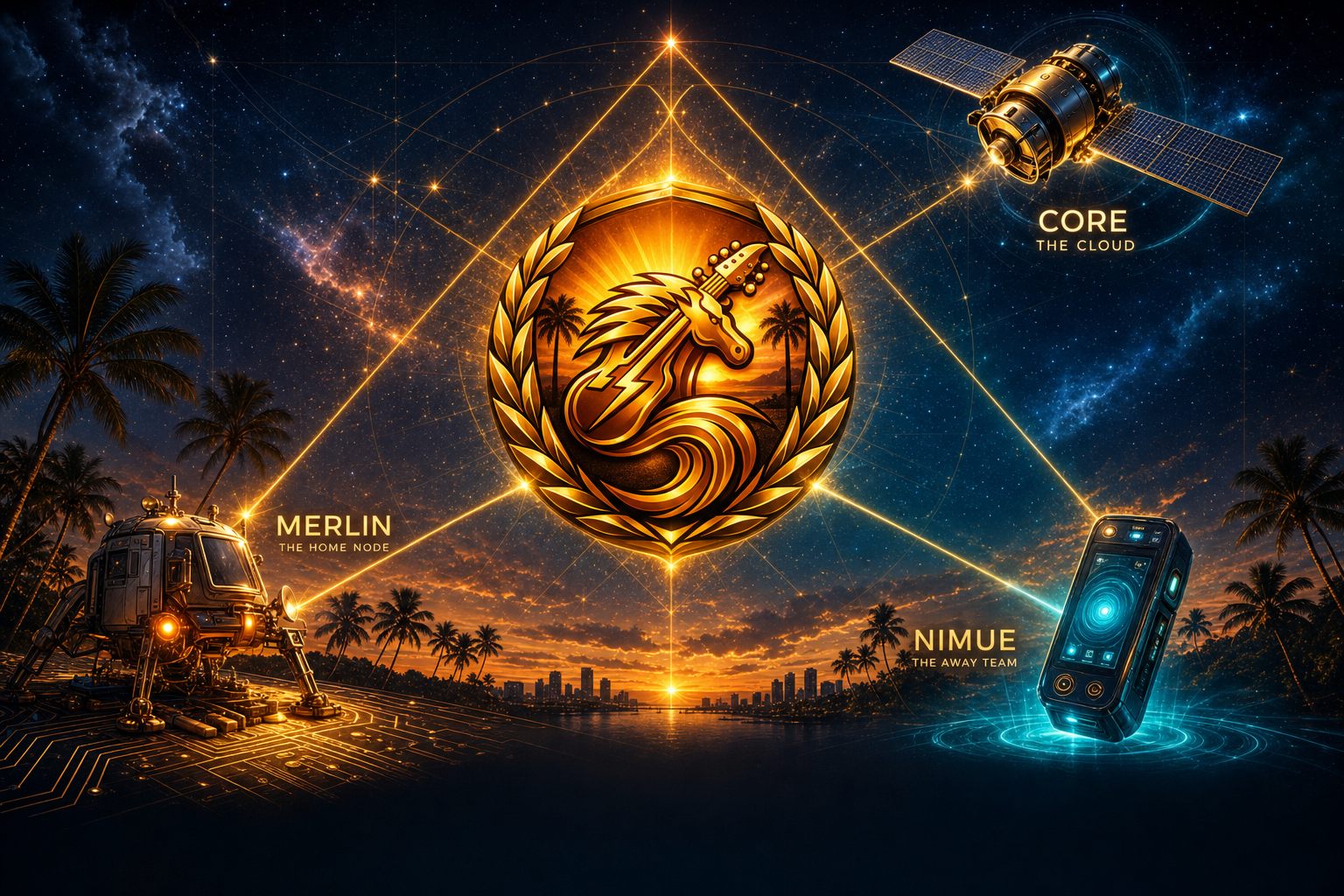
he Angel OS is three bodies sharing one mind. Core is the cloud — the federation backbone. Merlin is the home node — Nimue is the handheld
.png)
One Mind, Three Bodies: Why This Architecture Matters
Most systems talk about “unification” as a UX problem. Angel OS treats it as an architectural contract. “One mind, three bodies” isn’t branding — it’s the…
.png)
THE WHEEL THAT NEVER STOPS TURNING (A fragment from the near edge of the future)
The first thing you have to understand is that nobody built the White Entity. That's the part the historians still get wrong. You don't build a thing like that any more than you build a wave.